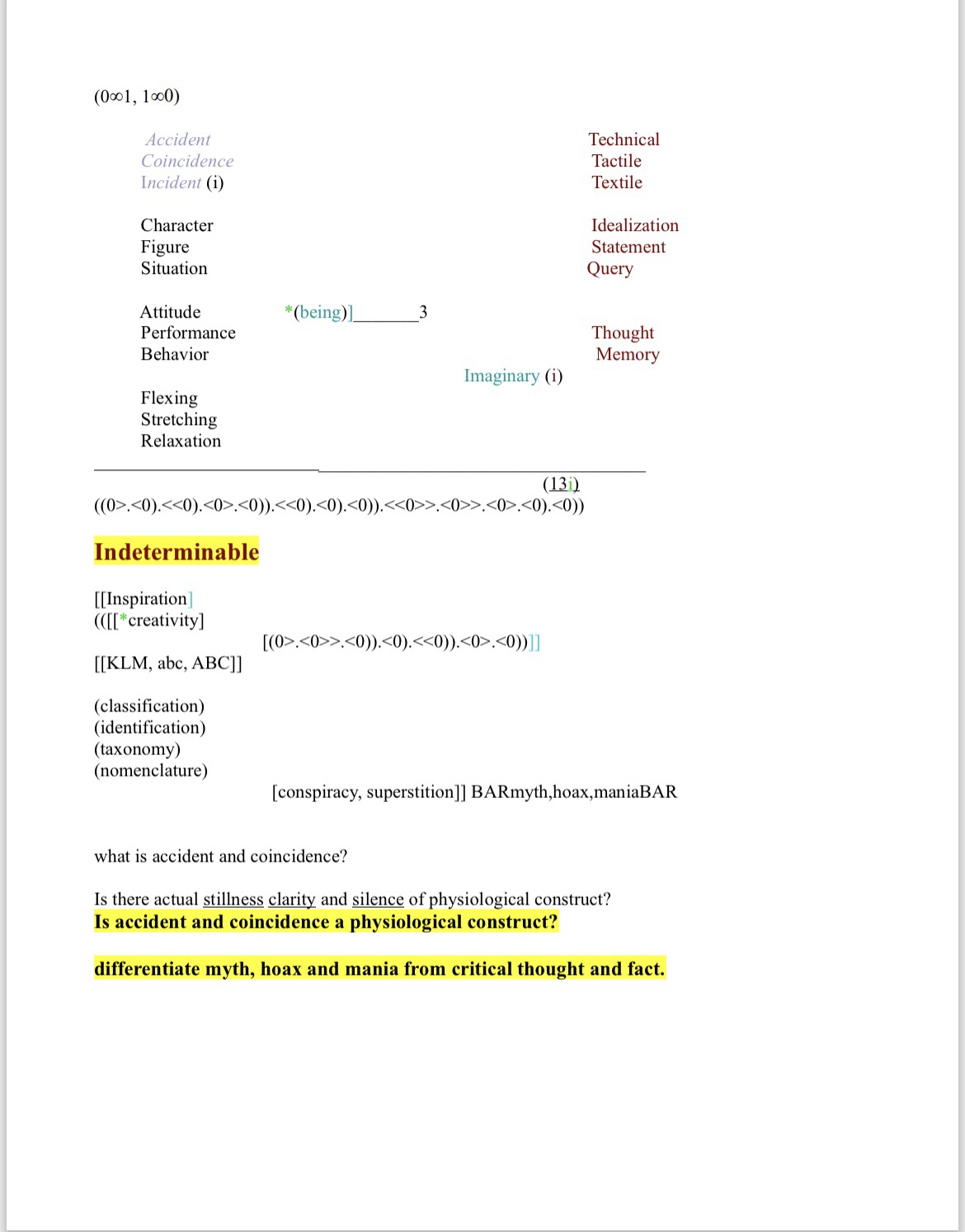
Accident and coincident as forms of physiological constructs of metaphysical data, of the existence of silence clarity and stillness from physiological constructs, and of the use of and need for accident and coincident in bodily functions. Are accident and coincidence physiological constructs? Is there actual clarity, stillness and silence physiologically? What is actual accident and coincident? The accuracy in calling accident and coincident physiological constructs of metaphysical data, the want for a working definition of metaphysical data and the ramifications of regarding accident and coincident as metaphysical.
That which I seek has no proof, and cannot be found: it hasn’t been hidden, it hasn’t disappeared. The more you seek it, the further it is removed from you (it being innate, even then…). I don’t work to answer questions, but to ask better ones. There are always alternatives, there is always room for uncertainty. Every single answer has at least two and depends upon the measurements, instruments, and observers involved. For every perfect explanation, there are at least three that would fit and make sense, and any number of others that could work. I’m never going to work to determine that which is indeterminable, but work to ask better questions about it, and give myself definitive boundaries to seeking out curiosity.
Unexplainable happenings of thought, the ramifications of thinking of it too long and the refinements of inspiration. The instants of chance just before or during actual thoughtlessness, the nature of indicatives and the pre-described socio cultural norms that dictate the organization of information. The digestion of information and its reliability in conditions of normality and those situations that seem just beyond the normal becoming easily misconstrued and automatically recorded incorrectly. The distance between thought and the imagined ramifications of density in emotion catering to any amount of supposed information, the process of process and inspiration becoming absolutes instead of more accurate. The need for accurate record of imaginary and mental space. (even writing is me imagining thought, not the actual thought itself)
The want to record imaginary data, thought and its indicatives, the need to understand where thought comes from and the ease of manipulation in the coincidences and accidents that make thought and so many other physiological constructs possible. The want to name and claim incidences of natural coincidence and accident are nothing new: the need for accuracy in any sort of metaphysical data could find some thresholds in the record of accident and coincident accurately and without mystical claiming of natural events. The natural precognition that every animal experiences to a certain degree doesn’t need to be taken out of context or applied as though specific when obviously ambiguous. Metaphysical data has physiological constructs of operant imagination that definitely depends upon physiological constructs to exist and which can also cause them spontaneously or in accordance with outside stimuli. The powers of the imagination!
Collective belief and hypnosis could account for any number of instances in which natural phenomena are taken out of context and used outside of situation and in neglect of reality. If enough people believe in any amount of information, the reliability of fact can be significantly diminished in favor of whatever the crowd would like to believe, and what they substantiate themselves in belief from natural phenomena oftentimes dominates the facts. Popular belief and the hypnosis that goes along with it are nothing new, and crowds have been creating experiences for as long as there has been such a thing as a crowd. Hey, if enough people believe it, or believe it happened, it must be true, right? The ease of ambiguity and the conceit of experience of the extraordinary create interesting dynamics for information, especially that pertaining to metaphysical data. The need for information reliability and the accuracy of record of data tend to work somewhat toward isolation of experience, rather than a hive-mind experience. There are usually actually very differing accounts of what could have happened or what was supposedly perceived that are never heard in favor of what’s recorded of ‘the crowd’.
Manufactured responses and fabricated evidence in first hand accounts of imaginary space and mental event are nothing new: in need of information reliability in seeking out accurate record of imaginary events. Taking natural phenomena out of context and putting ambiguity in situations it doesn’t belong in is easy to do, especially when recording imagined event or mental event, and collective belief is an easy thing to skew, especially in large crowds. Manifestations of imagination and the will of the observer in the record of imaginary and mental event hinder accuracy and oftentimes cause dilemma where there needn’t be any. Oftentimes, it’s the power of collective belief showing signs and making wonders of naturally occurring phenomena that there is limited understanding of. The natural volatility of change and coincidences and accidents necessary to biological existence don’t need taken out of context and given meaning or cause: accidents happen, coincidence is plenty.
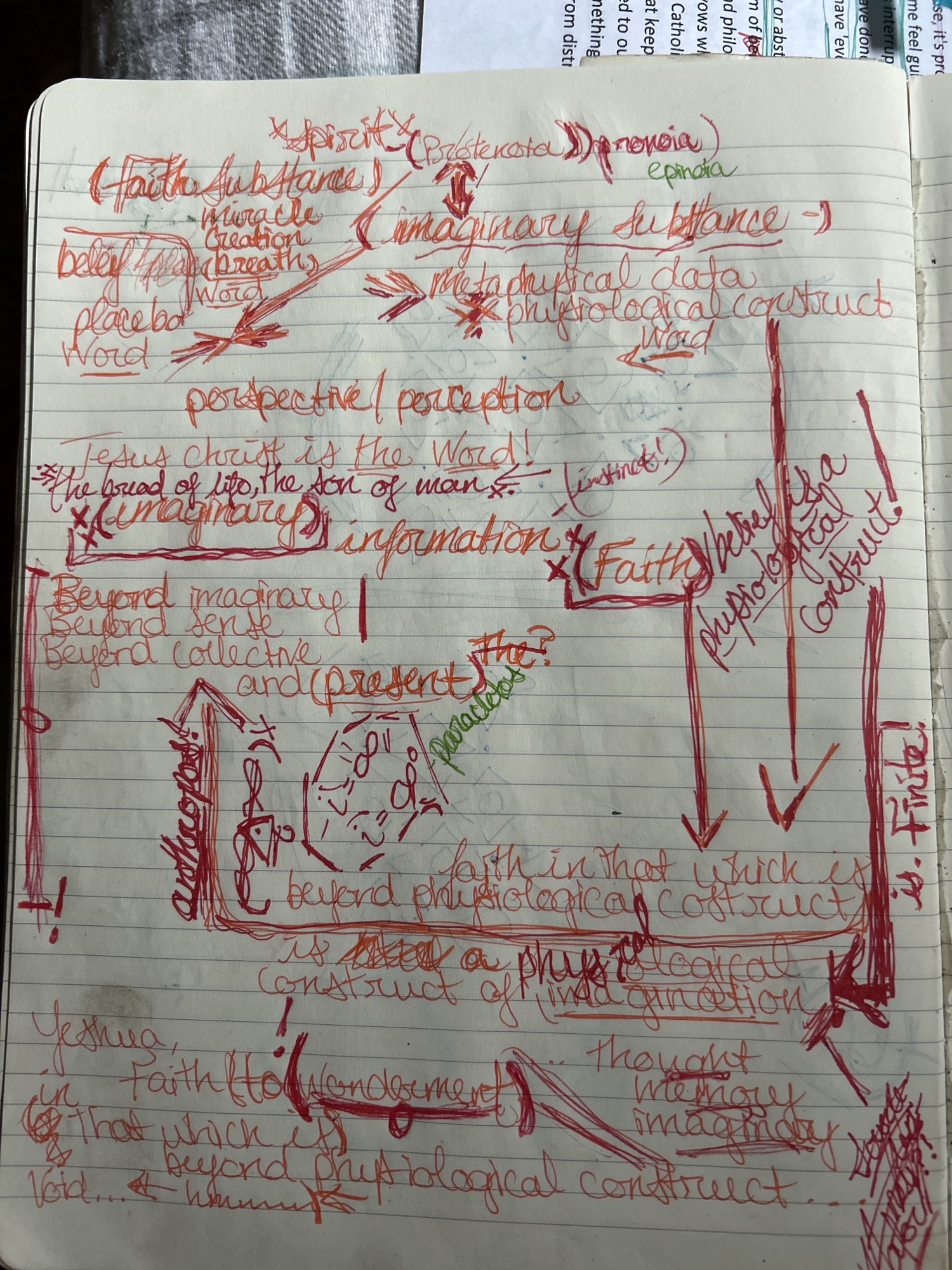
Metaphysical data usually has physiological constructs, even if only of imagination, there is a physiological construct to any amount of data that can be produced. Even the most outlandish first hand accounts of mystical data still rely upon bodily inputs of data, of a sense for or feeling of, and depend upon a physiological reaction. Trying to describe a bodily sense of something happening without the physiological senses isn’t possible, and every instance of metaphysical data must have some form or another of physiological reaction or wouldn’t be recorded. Imagined reactions can become real to a certain extent, and if inward stimulus can effect and affect the environment as it often does, it’s really just another record of imagination and the powers therein. Not to belittle these happenings, but they definitely have a physiological construct of some sort, and we don’t have any perspective at all on things that are beyond perspective, beyond body. (Extra-sensory), how could something you feel be beyond YOUR senses?
Motion is not emotion and can easily be mistaken that way. Some parts of sub or unconscious movement may indicate parts of thought, but to observe as though any posture has a particular meaning, even if given a situation, is outlandish and unfair. How many different ways a frown or a wave could be taken! The ambiguity of validity multiplexing in a multiverse: any number of different things said or done could be taken into or out of any given situation, deriving meaning that was never meant or giving intention that was never felt to fit another’s thought life or collective understanding. This is a dangerous miscalculation of the possibilities in thought and metaphysical data, and is taking natural phenomena out of context to derive meaning and cause where there needn’t be any. For every instance in which you could guess, there are at least two that couldn’t even be presented as options and any number of other possibilities that are diminished by the assurance of absolutes and especially of absolute meaning to any movement.
Attaching ultimatums of meaning to environments is irresponsible and inaccurate. To have perspective is one thing, to claim your perspective could beset an entire environment is definitely another. Claiming entire environments to specific perspective is nothing new, and the ramifications are well known: same types of authoritarian and totalitarian thinking that gift some white settlers with manifest destiny and homesteading and leave the rest to the promises of free land never fulfilled. Every object changes every time you see it, whether that’s recognized or not, and cannot hold the same meaning as it does for observers or/and those outside the environment itself. You can’t have accurate perspectives of environments you’ve never experienced in real life. Even then, perspective is perspective and there is always another one.
Music, like an expression, is almost easier to take out of context than even a postural reflex or bodily expression, and can mean any number of different things depending on the observer. To say you observe is an opinion, and even Leonard B. Meyer in his study of information didn’t pretend to be beyond the will of the observer in recording indicatives given by and taken from music. Getting caught up in a moment, in a song that could apply so well you would think it were specifically for you for moments of time, part of why so many love music and part of an idea of musical linking of differing events to a whole that makes sense. Musical determination of events can seem very accurate, but still depends upon the will of the observer to apply, and on the will of whatever is being supposedly observed. That type of coincidental sense depends upon the perspective of those involved, and even if no one were technically involved, would be dependent upon the will of observers or their prior observations and record.
There are many physiological constructs that are beyond our understanding and that could indicate accident and coincident as metaphysical data. Especially in the ways in which our cells communicate with one another and the spaces beyond space that can accumulate and register sources of energy when there is no source present. Or, of course, in the conversions our bodies make of chemical to electrical and electrical to chemical data. Antibody dependent cell mediated cytotoxicity, like T cells interferon and interleukin cytokines to B-cells immunoglobulins is a simple well understood interaction of communication within the body, but how does the nucleus just know? How is it that information can pass distances of an entire body without registering with any part of my conscious brain? How do these signals in chemical and electrical inference become known overall, become able to be easily read by other cells and reproduce signaling of their own? The actual data of precognition or thought construct exists beyond our conscious will, and is part of a physiological construct that doesn’t need to be misconstrued, that could very well have some of the same energetics as so many other unexplainable communications on a macro level. Data as nutrients, how does each partial message become a whole and perfect part of another? How is it that bacteria anywhere on the planet morphs and grows with all the other bacteria of its kind? messages that we can’t read…communication beyond bodily ‘capabilities’, but of the body. Are communication and thought dependent upon some forms of accident and coincident?
A morphological continuum of exiting while combining entrance ways, phases and phrases of numbered letters shifting gaps to volume after volume of numbered letters, reference and cognitive selection strategies: thought and its precognition. Descriptions of thought, wonder for inspiration and information, the ways in which we digest and absorb data and its effect on recall and retention. The organization of information having effect and affect upon its usefulness and popularity, the idea of a thought working to become knowable in data and the references necessary to any process of cognition. Generalities and holotypes of thought and its decidability aren’t accurate enough to the individual, and every cognitive process is a new one. Especially in potentiality and precognition of data, I can’t know what I already know, or what some parts of my mind have already taken in, let alone what others might conceive therein. Of all the processes I will never truly know are already going on. Guessing at the potentials of non-conscious data doesn’t seem conducive to accurate record of imaginary and mental event.
Shifting reticulum in neutral spaces of combinative value assorting data according to matter, using pause and stillness as medium for movement, creating gaps for reasoning and projecting potentiality in accordance with shifting matter. In favor of (parable and paradigm) proximity over likeness, comparing distal invocations of process and thought to values of rhetoric. Testing usefulness and comprehension beyond any cognitive strain, automatically making room for that which seems to fit or could, and automatically discarding possibly useful information at the same time. Impression and thought, that which seems or becomes useful to us and that which we automatically disregard. That which seems to come from beyond, processes of inspiration and the idea of shifting matrices of thought interjecting according to matter and subject. Far beyond subject and a matter of that which is mostly beyond it, the coincident and accident of being inspired. A physiological construct of data that is beyond body: imagination and the capabilities therein. Is inspiration a matter of imagination? What parts of thought could I separate entirely from imagination? Is imagination shared?
Movement of thought within the mind, chance change and the ways in which we see and digest motion/movement of thought and process. Shifting differential sampling of gaps? Phase and phrase of differential shifting of gaps. The involvement and assimilation of information dependent upon chance gaps and shifting probability. The intuitive cognition of information beyond its actual rigorous use and the usefulness of intuitive guessing. Differences in shifting mediums of gaps of information, the gaps forming the data itself from postulates of potentiality and immeasurable stances of phase/phrase in language. The phase and phrasing of thought and data to rhetorical situations of sense, conditions of decidability and the solvability of radical and random information. Differences in random information and the shifting relevance of consideration and inspiration. What parts could shift or recombinate from data that is not present? What parts of this will actually formulate sense and what sorts of selection strategies do we partake in without even recognizing it? The want to understand the movement of thought within the mind, to understand inspiration and its possibilities in the sharing of information beyond communication.
A want for accurate record of imaginary space, writing being one form of record still wanting of others and the beauty of the possibilities therein. The thoughtlessness of writing indicatives and thought itself, the want for reliability of information in the seeking out of alternative mediums for record of imaginary and even thought beyond the limited reliability of what’s written. Imaginary creating data, thought perhaps far beyond any amount of indicative in any medium, and only another form of writing a close carry of what’s being imagined or inwardly digested. Imaginary is imaginary, and as accurate as imagining my thought could get, it’s still far and removed from what’s actually being thought. How many different frames of thought could the average person have? What parts are left out or beyond, which parts tend to present themselves for presentations? Writing of other mediums of thought, imagining the accuracy of actual thought and its indicatives while supposing new ones.
The experience of imaginary sight and sound, the indicatives of perception and the ways in which we digest imaginary and imagined information. The constructs of presence and the intensities of thought about thought itself, about the separations of thought and imaginary, of the possibilities in imagined stimulus and the physiological reactions to imagined stimuli. How is it that I could imagine something and know its only my imagination but experience bodily reaction? The powers of the imagination in process and inspiration, mental and imaginary event causing physiological response and confusing the reality of stimulus: some of the difficulties in the accurate record of imaginary space and mental event. Imagined response in writing becoming at least part of that which is then spelled out, the possibilities of shared imagination and the ideas of inspiration pertaining to imaginary space and mental event are easily confused and oftentimes cause curios reactions that get recorded instead of the actual event. Here is another physiological response to imagined stimuli, that could seem as though it is becoming real, that is part of the construct of data being added to and referred to and that is also separate and brand new. The powers of the imagination: I could imagine thought, imagine memory, imagine the past or future, could imagine anything, but it remains imaginary. Even if and when my imagination produces physiological responses, the data that caused it remains imaginary, and the physiological response will probably make accurate record of whatever mental or imaginary event that much more difficult. Instead of recording the actual mental or imaginary event, I’m more inclined to record my experience. As close as my imagination could get to others thought or real events, it is imagination regardless. Imaginary is imaginary.
I can only have thought and perspective analogous to mine own alone. In wanting to seek out inspiration and how it works, and especially in the ideas of shared imagination, it’s important to remember that I can only have perspective analogous to mine own alone. To say I observe something is an opinion from my perspective. I cannot trust instincts when it comes to imaginary space and could assume others perspective and dilemma, but would probably be creating it for myself, if anything. I don’t want to create events to match up with my own imagination, it would only confuse the process of wanting to record actual imaginary and mental event. Meaning and cause so readily applied to any event, I don’t need to apply my own meaning and take events out of context and it’s easy to do. Just because an event could register with me as important, doesn’t mean that importance is recognized or shared, and definitely doesn’t mean that cause should be applied at all. I don’t need to claim others accident and coincident as though they operate for me, and this is one of the most frustrating parts of studying metaphysical data: the claiming of accident and coincident to human understanding for control and contortion of data. Information reliability and the need for accurate record of imaginary and mental event, coincident and accident.
Copyrighted 2020